

By Adam Cortez, Digital Marketing Supervisor
This past year has been a transformative one for marketers. Content creation has never been easier with artificial intelligence, and with PPC costs continuing to rise for most industries, organic search remains one of the most affordable ways to reach target audiences online.
Understanding and utilizing the latest SEO trends in 2024 can help you stand out and stay ahead of the curve with your SEO strategy.
New SEO Trends in 2024
In 2024, the focus will be on the future of SEO with AI. Mainly, how Google and users respond to the mass influx of AI-generated content flooding the internet. While some marketers will exploit the powerful technology to pump out less strategic, AI-generated content, those who take additional steps to create the highest-quality content possible will soar to the top of SERP (search engine results page) rankings in 2024.
Google wants to provide the highest-quality search results from the most trusted, reputable, and authoritative sources to its users. And with AI-generated content permeating Google algorithms and muddying the waters, it’s likely backlinks, brand signals, and other authority indicators will see a resurgence this year.
Following key SEO trends and techniques will ensure your content meets the latest quality and authority signals put forth by Google. Let’s break down the 12 biggest SEO trends in 2024:
The bottom line? Make these SEO trends work for you in 2024.
If you’re committed to SEO success this year, here are the 12 most important SEO trends to consider:
- Focus on creating content that meets the needs of users
- Answer questions that users have about your products, services, industry, or topic areas
- Ensure your content creators have first-hand experience, and showcase it accordingly
- Build topical authority through high-quality content that explores topics in breadth and depth
- Use topical maps to build out comprehensive content strategies in 2024
- Leverage AI content tools to increase your content velocity and improve the efficiency of your content workflows
- Regularly update your content for relevancy and freshness
- Improve your brand signals on third-party websites and aggregators
- Allow users to interact and engage with your content
- Make sure your mobile pages are fully-optimized
- Continue to focus on page experience and prepare for upcoming Core Web Vitals updates
- Join SEO communities to stay up-to-date on the latest SEO trends in 2024 and benefit from the power of collaboration and experimentation
1. Search intent will be king

Search intent will continue to be the North Star for organic marketers creating content this year.
Search intent refers to the true intention behind a user’s search. Meeting search intent with the latest Google algorithm updates requires a nuanced understanding of how your target audience uses search engines.
Marketers traditionally have used four primary categories to discuss search intent: Navigational, Transactional, Commercial, and Informational searches. A recent study found that transactional and commercial keywords appear on the rise, while informational and navigational queries are declining.
Many keyword tools display search intent alongside valuable keyword metrics—like search volume and cost-per-click—to provide insights into the intent behind target keywords.
However, to understand what Google believes users are looking for, it’s still important to study the top-ranking results. While the four categories of search intent are helpful, comprehending the type of content users expect and their exact needs continues to be essential.
Are they seeking a quick answer? A detailed explanation? A product page? An actionable guide? A video tutorial? A list with multiple options to compare? Will they likely have follow-up questions to their initial search query that you can answer before they even ask them?
Artificial Intelligence tools can replicate the topics they see in top-ranking results but lack the human touch necessary to consider users’ exact needs.
Google recently simplified its Search Rater Quality Guidelines and how it defines content that meets users’ needs. That simplification, however, does not mean that your content should be any less high-quality or helpful.
Rather, it means that Google genuinely cares about ranking the most relevant and useful results, and wants webmasters to understand what quality content looks like. To reach the top of the SERPs through target keywords, your content must indicate you understand what users are looking for and their needs.
2. Increase in question keywords and answers

Many current SEO trends will become even more important in 2024—none more so than answering questions. According to MozCast, “People Also Ask” results appear in over 90% of searches.
Although Google is simplifying how they display answers to questions (they got rid of both the FAQ and How-To rich results in 2023), answering questions is still a great way to get on the first page of results.
To find questions, you can look directly to the SERPs to see what questions populate the “People Also Ask” feature. You can also utilize keyword tools that identify related questions from a seed keyword. Then, find ways to incorporate those questions and answers into your content through strategies like:
- Adding FAQ sections to your web pages. These can be easily incorporated into your web design through expandable dropdown menus.
- Create blog posts around questions that require detailed answers. Use H2s to introduce high-value questions related to a topic in the body of the section that provides answers.
- Implement a “Commonly Asked Questions” page about your products or services. These pages can double as a great resource for customers and sales teams and a powerful piece of SEO content.
Additionally, question keywords often have lower Keyword Difficulty, making it easier for question keywords to rank higher on Google. This makes them a compelling tool for newer websites.
Running Google Ads along with your organic strategy? Find out how you’re doing with a free, instant audit >> Google Ads Performance Grader.
3. Creators will share more first-hand experience

Just over a year ago, the Google algorithm updates added “Experience” to its E-E-A-T algorithm a little over a year ago. With more AI-generated content on the web, first-hand experience continues to factor heavily into the latest Google trends and SERP rankings in 2024.
There are several ways to leverage your experience through content strategy. Consider adding the following elements when developing content:
- Real-world examples: Whether from clients, past customers, or personal experiences in your industry. Real-world, personal, and original examples are things AI can’t replicate.
- Case studies: Case studies spotlight your work with past clients, customers, and the tangible results of first-hand experience in your industry.
- Data and insights: Hard data and statistics gathered from in-house research or reporting are great for building credibility and highlighting your real-world experience.
Including bylines, author bios, and links to content creators’ social media profiles will further showcase your content’s authority and authenticity.
For example, I’ve established my experience as an SEO professional, writing articles about SEO keyword trends, creating social media posts explaining “what is SEO,” and constantly updating my personal social content with the latest SEO news and trends.
As a result, Google now associates me as an SEO professional with first-hand experience in that area.
This not only benefits the organic ranking potential of my published content, but also makes me a more valuable guest blogger or author on other websites.
So, if you are writing your own content in 2024, make sure you’re leveraging your experience. If you are hiring content writers, consider their experience during the vetting process.
4. Building topical authority will enhance your SERP ranking

Topical authority has been important to Google for years and is particularly crucial for news, health, finance, and political websites.
Google’s Topic Authority system prioritizes rankings for websites that have more expertise in specific topics or coverage areas.
But even websites of those niches should strive to build topical authority in your industry.
Topical authority is primarily displayed through:
- Content breadth: Multiple pieces of high-quality content that explore all the related subtopics of your primary topic areas.
- Content depth: Detailed, in-depth articles that answer all of the questions related to those specific subtopics. It’s also helpful to include original reporting and insights (i.e. “experience”).
- Internal links: Links between relevant pieces of content that show users and search engines both the breadth and depth of your content offering.
For example, say you have a pet website. Take the time to build out hundreds of pieces of informational content about dogs with subtopics like dog breeds, dog health and wellness, dog nutrition, and more.
What’s the benefit of all that content depth and breadth? Your website is likely to rank for many lucrative keywords.
High-quality backlinks can also showcase your brand’s topical authority. If a lot of relevant websites in your industry are linking to your content, it tells Google your website is considered an authority by others in your industry.
Promoting your content in public relations, digital PR, and social media so that others can link to your site is a great strategy to build topical authority in your niche.
5. Topical maps in content strategy will be huge

Topical maps will be a major SEO trend in 2024. Why? Because these tools provide a roadmap for how to build topical authority.
A topical map outlines all of the SEO content needed to cover a particular topic in breadth and depth. Here’s an example of a topical map created in spreadsheets for technical SEO.
In the past, manual topical mapping required hours of keyword research and keyword clustering. However, with the help of artificial intelligence, topical mapping can now be completed fairly quickly.
Why is topical mapping so important? It allows you to generate a comprehensive SEO content strategy—fast. Your content team can accurately pinpoint the topics that need to be covered and which target keywords to utilize to optimize content and establish authority in your niche.
Then, you can leverage AI content tools to help generate content ideas and outlines around high-priority topics. Or, you can send topical maps to help guide your content writers. Repeat the process of topical mapping for each of the primary and relevant topic areas for your website.
Adding those content pieces to your website and showing their relationship through internal links is a great way to earn hundreds to thousands of new organic keyword rankings in 2024.
6. AI content will be created at scale (for better or worse)

Experts estimate by 2026, 90% of online content will be synthetically generated—creating significant questions regarding the future of SEO with AI.
Many AI tools empower marketers to create content in bulk, allowing them to generate all of their topical map’s content (hundreds of articles) in just a few hours. In 2024, our collective content velocity will blow through the roof.
While AI-generated bulk content is not against Google’s guidelines, it must be valuable, high-quality, helpful to users, and meet E-E-A-T guidelines. As stated in Google’s guidelines, this content is only a violation if used “to produce content for the primary purpose of manipulating search rankings.”
As AI gets more intelligent and skillful at mimicking SEO trends to generate high-quality content, the vague lines Google draws will become more complex and complicated to define and penalize. Will some marketers leverage the power of automation to create average content with rich-in-focus terms but low on value to gain organic traffic? Certainly.
However, it’s still best to look at AI outputs as a starting point, rather than a finish line. The most effective content creators of 2024 will use AI to streamline the writing process and implement the latest SEO keyword trends while still taking the time to meet search intent, showcase their experience, and provide the most valuable, helpful content for users.
Marketers must realize that AI content is the new frontier of SEO. Some competitors will likely use AI content tools to facilitate the implementation of the latest SEO trends in 2024 and create hundreds or thousands of new pieces of content throughout the year. Failure to utilize AI technology will leave you outside of Google SERP rankings and behind the competition.
Not sure what tools you should be using or where to start? Check out this list of AI content tools to find options that best fit your needs.
7. Content will need to be regularly updated

With the influx of AI-generated content coming our way this year, keyword competition will significantly stiffen. If you have a piece of content currently performing well, protect its positioning by updating it regularly.
Google’s ranking algorithm still maintains some recency signals that will likely create fluctuations in top-ranking positions as new content is posted. However, backlinks, topic authority, and content quality will beat out recency in the long run.
In the past, updating content every one to three years was sufficient for maintaining rankings. However, in 2024, yearly content refreshes should become standard workflow practices.
To optimize SEO during content refreshes, here are a few suggestions:
- Confirm that all data and statistics are accurate and the most up-to-date.
- Link to the newest research, case studies, and news articles.
- Rewrite the content. That means entirely new introductions, insights, and examples.
- Check all internal and external links. Repair broken links or replace links with 301 redirects.
- Keep building backlinks! A content refresh or rewrite is a great opportunity to promote your content on social media, public relations, and to existing email subscribers.
8. Brand signals will grow in importance

With so much synthetic content, your brand’s name and reputation will hold SEO power in 2024—so long as you’ve done the work to establish your brand name online.
Let’s be clear: Google does not prioritize big brands over smaller brands in search engine rankings. But Google uses signals like branded anchor text and branded search volume to determine whether your website is well-trusted and authoritative.
As Google continues to emphasize experience and expertise in separating the wheat from the chaff in content, there’s never been a better time to embrace and leverage your brand name.
Here are a few simple ways to improve your brand signals for SEO purposes:
- Link to your social media pages from your website and vice versa. This shows Google that your website has a social presence and life outside of your website.
- Have robust “About” and “Contact” pages. Highlight the fact there are real people behind your website and content—and that they are experienced!
- Invest in public relations outreach. Links and brand mentions on authoritative websites enhance credibility as a brand, business, or organization.
- Get listed in directories, review sites, and third-party aggregators. Focus on quality over quantity and prioritize sites that have relevance in your industry. For example, a plumbing company should create a listing on Thumbtack, while a software company should set up a profile page on G2.
These brand-building efforts can also lead to more appearances in Google’s rich results. Want to appear more in lists like this? Google extracts the data about these brand names “from across the web,” not just from the brand’s websites. The efforts you make to establish your brand name on reliable sources across the internet will help Google understand who you are, what you offer, and your brand’s authority in its market.
9. Google will place more emphasis on user interactions and engagement metrics

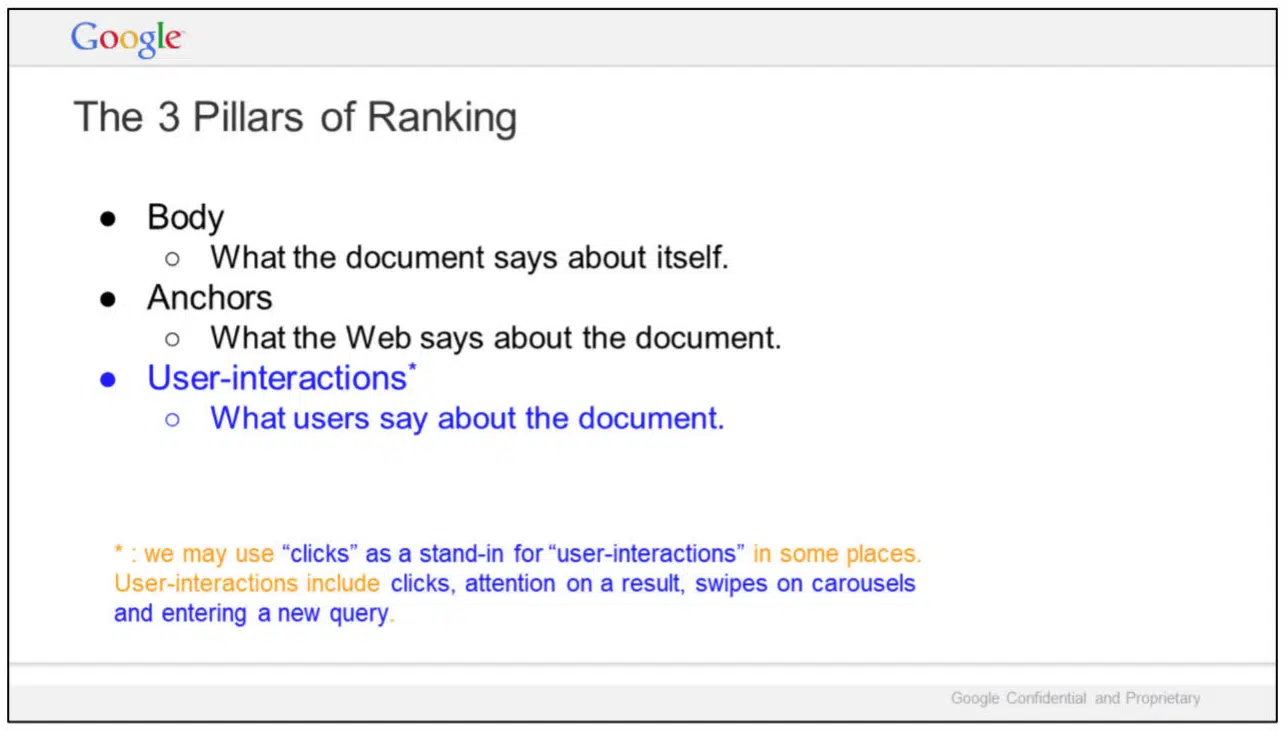
There’s been great discourse among SEO professionals regarding the degree to which Google uses engagement metrics in its ranking algorithm. But documents from the recent antitrust case against Google show that user engagement is not only a ranking factor–it’s a pillar of ranking.
The below slide from Google’s presentation titled, “The 3 Pillars of Ranking,” lists “User-Interactions” as a core ranking factor. It also clarifies that “clicks, attentions on a result, swipes on carousels, and entering a new query” all qualify as user interactions.
When leveraging the latest SEO trends to generate and optimize content, it’s important to consider how your web content allows users to interact.
Interactive modules like jumplinks and carousels have long helped enhance page experience. However, now, when users click on them, they can show Google that users find certain content engaging and valuable.
As always, be careful not to be too spammy when trying to increase interactions. These interactive features should benefit users’ experiences, not disrupt them.
10. Mobile page performance will continue to be a big SEO trend in 2024

After years of implementation, Google’s Mobile-First Index was officially completed in October of 2023.
You’ve likely been hearing of mobile pages for years, so it’s hard to consider this an SEO “trend,” but it’s essential to understand that your mobile pages, and your mobile pages only, are what count toward rankings. Even if your website primarily gets desktop traffic, this still applies to you. You need to pay attention to your mobile pages’ performance.
Here are a few “musts” for your mobile pages:
- Responsive design: Your web pages need to be responsive in 2024, meaning they can serve the same content on mobile, tablet, or desktop from the same URL. Separate URLs for mobile and desktop are a thing of the past, and the latest Google algorithm updates discourage anything but responsive websites.
- Proper character counts: Remember that meta descriptions on mobile are limited to 120 characters (not the 160 given on desktop). It’s best to trim up all meta descriptions and routinely aim for 120 characters.
- Check that your pages are mobile-friendly: QAing your mobile pages should be a standard practice in your publishing workflow. You can use Google Search Console to confirm whether your pages meet Google standards. Go to “Experience” > “Core Web Vitals” > “Mobile” to get a complete report of your mobile pages.
11. Businesses will need to make page experience updates

In April 2023, Google expanded its guidance on page experience and discussed the role of page experience in helpful content.
Essentially, a poor page experience is the opposite of helpful. So your pages must be fast-loading, responsive, and pass Google’s Core Web Vitals.
In March 2024, Google added Interaction to Next Paint (INP) to its Core Web Vitals metrics. This metric measures a page’s response to a user’s interaction, whether a click or keyboard stroke.
With the importance of user interactions in ranking, this is a natural addition for Google to measure the overall quality of a page. Ensure you are ready for these additions by reviewing your INP report–currently available in your Google Search Console account.
12. SEO communities will be crucial

Although it’s not always discussed explicitly, SEO has long been an industry fueled by shared information and crowd-sourcing.
Community is an essential part of SEO success, whether for SEO professionals, agency owners, or entrepreneurs taking ownership of their SEO.
Of all the SEO trends coming in 2024, I believe SEO community groups will be one of the most important and beneficial for organic marketers. Sharing insights, strategies, or, essentially, shared experiences will help us all navigate the countless changes coming this year.
There are all sorts of ways to connect with other SEO-minded folks. Events, conferences, Facebook groups, online SEO courses, forums, podcasts, and LinkedIn are some of the primary ways you can find other people who care about providing high-quality content for users. These groups all focus on using the power of organic SEO and the latest SEO trends in 2024 to deliver results for personal or client websites.
The bottom line? Make these SEO trends work for you in 2024.